Is QuantumCat a broker?
No. QuantumCat is a terminal that connects to your existing broker account through that broker's official public API. Your money and securities stay with your broker; every order is executed by them under your credentials.
Do my keys or orders ever touch QuantumCat's servers?
No — there aren't any in the trade path. API keys live in your OS keychain (or an encrypted vault file on your own server for the web app). Orders travel from your machine to your broker, full stop.
Which brokers work today?
Zerodha (browser sign-in, including automated daily login), Dhan (access token — and the only one serving 20-level depth today) and Angel One (client code, MPIN and TOTP) all ship today. Each is modelled as it actually behaves, so a control a broker doesn't support is disabled with the reason rather than silently ignored. Upstox and Fyers are next. See brokers & sessions and the setup guide.
What happens to my stop-loss if my laptop dies?
Nothing bad — that's the point. OCO brackets and break-even stops are standing triggers (GTT) on your broker's servers, not in the app. Two honest caveats your broker also states: a trigger fires once, and a triggered order isn't guaranteed a fill any more than any other order. The only piece that needs the app running is the trailing advance — if the app closes mid-trail, the last planted stop keeps protecting you at the broker. Every feature is labelled broker-side or app-side so you always know which guarantee you're holding.
Can I trust the backtester?
You can trust it not to flatter you. Signals evaluate on closed candles and fill at the next bar's open, stops take priority inside each bar, and every simulated trade pays estimated Indian charges. If a strategy depends on live-only data the replay can't reproduce, it refuses to run and says why. It's still a simulation — treat results as directional, and paper-trade before going live.
Is QuantumPulse investment advice?
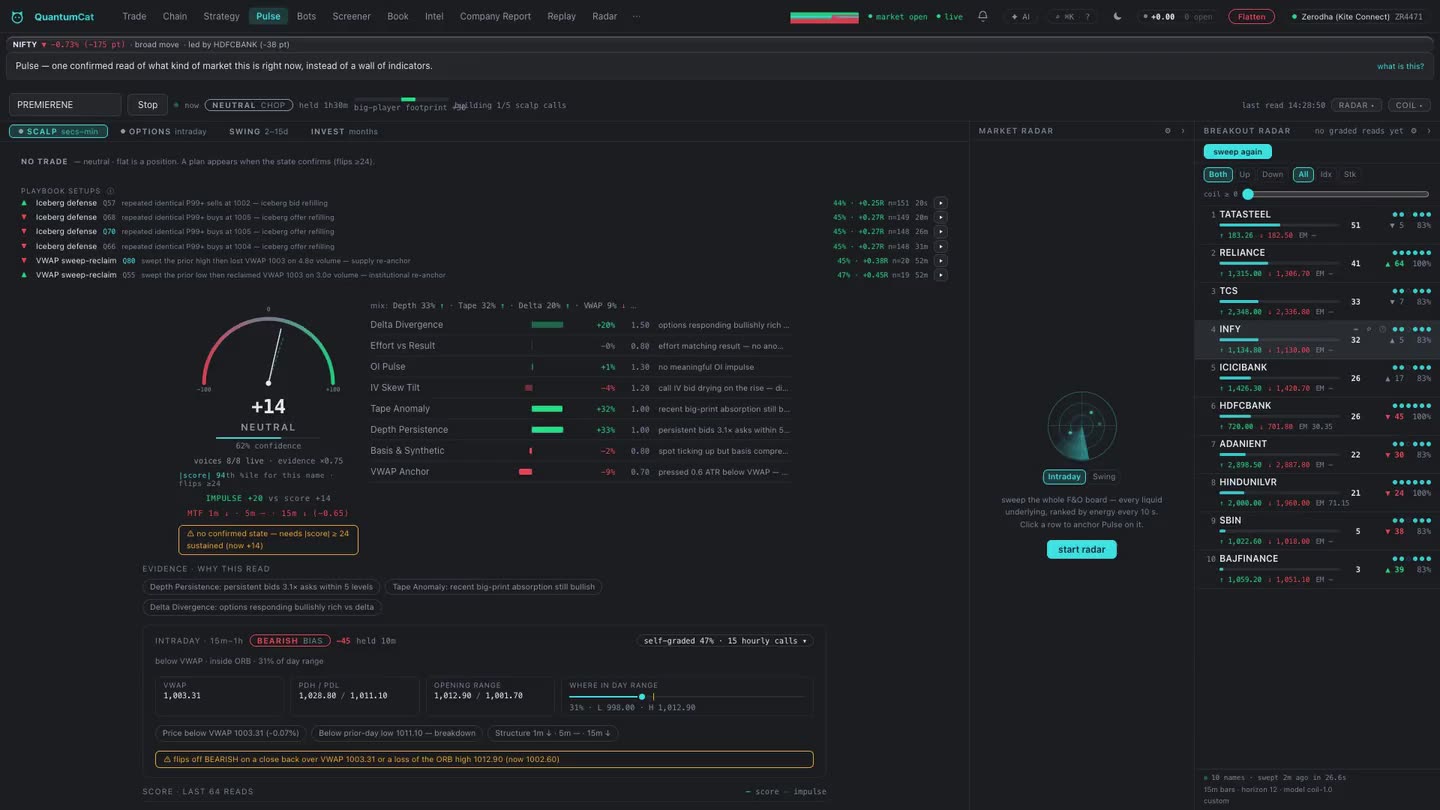
No. Pulse measures what is happening in market microstructure and shows you the evidence trail by trail. It never recommends a trade, and it can be wrong — markets don't owe anyone a pattern. You decide, you own the risk.
Does JARVIS place trades on its own?
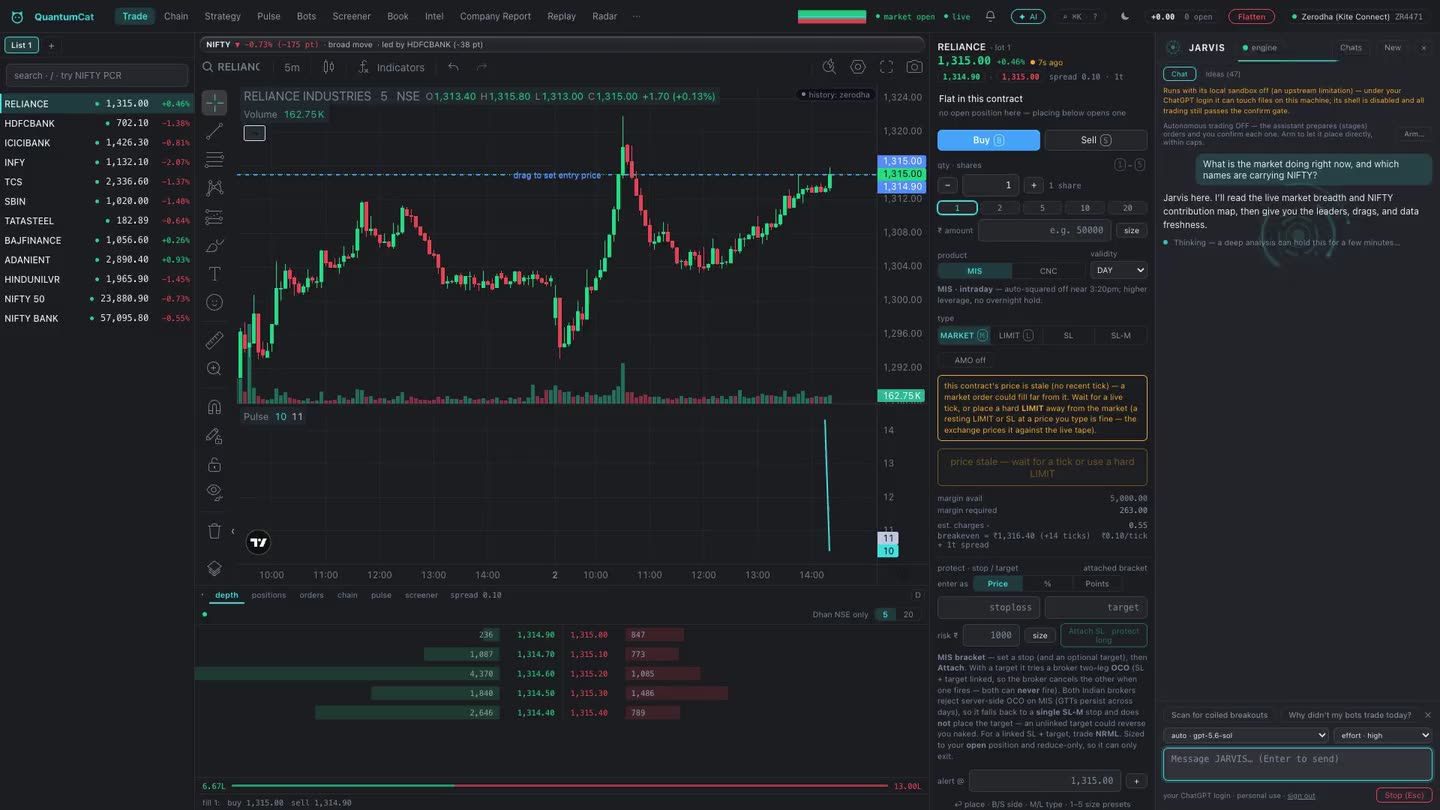
Not unless you tell it to. Normally it fills in your order ticket and leaves it for you to send — same checks, same confirm button as always. Hands-free trading is something you switch on by typing ARM with limits: how many orders, how big, a loss cap and a timer. It forgets all that when you close the app, and the kill switch stops it. It also has no path to your keys or risk settings — those aren't things it is able to do.
Do I have to pay extra for the AI?
No — but you need your own ChatGPT Plus or Pro plan. It runs on your subscription, on your machine. We don't charge for the AI, don't store your login, and there's no server passing your requests around. No ChatGPT plan just means no assistant; everything else works exactly the same.
How does the web app work if there are no servers?
You run a small gateway program on a machine you control — your Mac, a home server, a cheap VPS. It serves the identical engine to your browser and talks to your broker from there. Bind it to localhost or put it behind a VPN like Tailscale.
What about exchange rules for automated orders?
Bots place orders through your broker's official API within the broker's rate limits, and paper mode is the default. Depending on your broker and strategy, exchange algo regulations may apply to you — read your broker's API terms, and when in doubt, ask them. QuantumCat gives you the tools; compliance with your broker's terms is yours.
 Real build, recorded live